


Cleveland.com: Fixing Ohio's property tax mess starts by looking at all taxes: Kent Smith
Read the full column via cleveland.com...
Nobody in Ohio just pays property tax. People also pay sales tax and income tax. Everyone’s tax burden is a three-legged stool. Today’s property tax crisis didn’t just emerge overnight. It’s been 20 years in the making. It creates unfair burdens on local governments and those on a fixed income, but it is also out-of-balance when you compare Ohio to its nine Great Lakes and neighboring states.
The solution is to rebalance the stool in a fair and sustainable manner. Gov. Mike DeWine has created the Property Tax Reform Working Group, which made its policy recommendations late yesterday. But it will not find true solutions if it is only looking at one leg of the stool.
Here is why Ohio is out of balance: According to the Ohio Children’s Budget for March 2025, “Since 2005. Ohio has shifted money away from working class families and toward the wealthy and well connected through tax cuts and special interest giveaways. As a result, the wealthiest 1% of Ohio households are taking home, on average, over $52,000 every year in tax breaks.”
Over the past 20 years, the state budget has, time and time again, provided income-tax cuts to those with the highest incomes.
A generation of state income-tax cuts has left the mega-wealthy with even more and the struggling trying harder to make ends meet with even less. National and state data confirm this reality: Ohio’s median household income has not been above the American average since 2003.
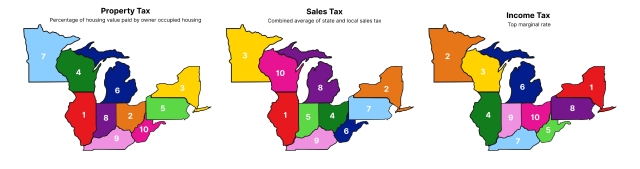
Ohio is also out-of-balance compared to our nine nearby neighbors; the data show that Ohio has shifted the tax burden to sales-tax and property-tax payers so that those paying income tax can get another cut. Compared to the other nine nearby states, Ohio has the second-highest property tax, an above-average sales tax (fourth among the 10 states), but the lowest income tax for those earning the most.
According to the Tax Foundation, property taxes in the 10 states, ranked by percent of housing value paid by owner in owner-occupied housing, from the most to the least:
- Illinois
- Ohio
- New York
- Wisconsin
- Pennsylvania
- Michigan
- Minnesota
- Indiana
- Kentucky
- West Virginia
According to the same source, sales taxes (a combined average of state and local sales tax), ranked from highest to lowest:
- Illinois
- New York
- Minnesota
- Ohio
- Indiana
- West Virginia
- Pennsylvania
- Michigan
- Kentucky
- Wisconsin
And, again per the Tax Foundation, state income-tax rankings based on the top marginal tax rate for wealthy taxpayers:
- New York
- Minnesota
- Wisconsin
- Illinois
- West Virginia
- Michigan
- Kentucky
- Pennsylvania
- Indiana
- Ohio
Look at Michigan and Pennsylvania: Both illustrate that a system of balanced taxation is possible.
Ohio’s out-of-balance system of taxation puts a greater burden on property owners – which includes businesses. When local communities get their state support reduced, they often have to put a property tax levy on the ballot, which makes operating a business more expensive and those on a fixed income more burdened.
In Ohio’s most recent budget, GOP leaders said we had to cut income taxes again for the wealthy and, because of that, we couldn’t afford to fully fund public education. Which will -- you guessed it -- force school districts back on the ballot for a property-tax levy. As a result, the Ohio stool will get even more out-of-balance, and Ohio’s property tax crisis will continue to grow.
State Sen. Kent Smith, a Euclid Democrat, represents Ohio’s 21st Senate District.